
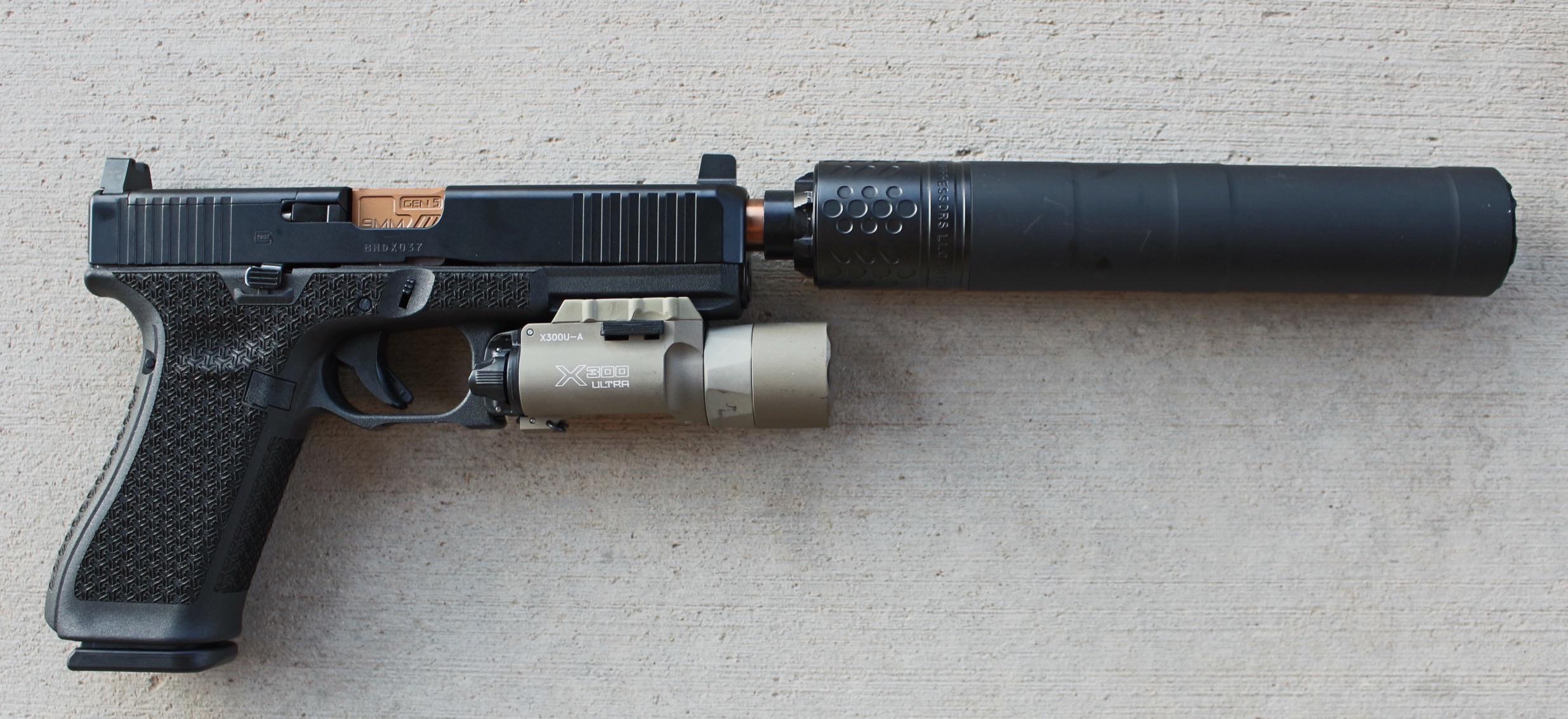
Photo Credit: Reddit.com
A pro-gun federal lawsuit came to fruition this week when a federal district court judge essentially said it is unconstitutional for the government to continue to regulate suppressors and other items under the National Firearms Act (NFA) tax stamp provisions after the Trump administration dropped the application/ownership tax stamp to $0 last year. The judge related it was unconstitutional because as a taxing practice, at zero dollars, the tax stamp raised no revenue and thus oversteps the congressional authority to regulate these items.
The government argued the 90-year-old NFA was not just organized under the taxing power of congress, and it could also be applied the commerce clause- but the judge rejected that argument.
Affected items include suppressors, short barreled rifles, short barreled shotguns and Any Other Weapons (AOW) defined by the statutes.
The suit was brought by Gun Owners of America (GOA), was brought by GOA, Gun Owners Foundation, Silencer Shop Foundation, Palmetto State Armory, SilencerCo, B&T USA, the Firearms Regulatory Accountability Coalition, individual plaintiff Brady Wetz, and a coalition of 15 pro-gun states: Alaska, Georgia, Idaho, Indiana, Kansas, Louisiana, Montana, North Dakota, Oklahoma, South Carolina, South Dakota, Texas, Utah, West Virginia, and Wyoming.
Internet gun sources are jumping up and down cheering the decision this week. However, the judge limited the holding to GOA members and the named plaintiffs- not to everyone in Texas or America. The rule is also held in abeyance for 7 days and is a permanent injunction on the requirements of the NFA for untaxed “firearms” so the DOJ and federal agencies like ATF cannot enforce this portion of the law.
What will happen next?
1. Most likely, in the next 7 days, the DOJ will ask the U.S. Court of Appeals for the 5th Circuit to block or overturn the ruling (this is part of the 7 day stay granted by the district court judge in his ruling.)
2. Regular NFA rules still remain valid and in place and can still be followed or enforced against those not named as a party to the lawsuit.
3. If the 5th Circuit Appeals Court agrees with the district court trial judge it will become law in that circuit. If they disagree, they could reverse the decision or return it to trial court level for additional work.
4. Since the topic is Congress’s authority to tax the NFA items and regulate even after there was no tax being collected the case could eventually make it up to the U.S. Supreme Court for interpretation as no other court can judge the power of congressional tax issues.
What is the impact of the court case in Illinois?
Nothing really. Illinois law banning suppressors, short barreled rifles and shotguns and AOW will still be illegal in Illinois. A federal district court action in Texas cannot repeal or invalidate Illinois state statutes. Even worse, if federal NFA requirements were finally struck down by the U.S. Supreme Court the state of Illinois can still enforce “restrictions” to gun laws. An action would need to be brought to the Supreme Court specifically against the Illinois law to have it be found unconstitutional.
Why are suppressors illegal in Illinois? Well according to legend, decades ago state legislators (AKA Chicago politicos) banned them because they were afraid people (criminals) in Illinois (Chicago) would use them to shoot people (extra illegally since it is already a crime to shoot people in a unnecessary manner).
Who knows how many people were not shot in Chicago with suppressors since then? So far this year, only 1124 humans have been shot in Chicago with loud and noisy guns. 1954 people were shot last year, 2979 were shot in 2024, 3077 shot in 2023 and 3603 in 2022 and a whopping 4543 humans shot in 2021.
So by conventional math 17,280 people were shot in Chicago in the last five and a half years with loud noisy guns.
Seems like the people doing the shooting are the problem.
Comments are closed.