
by Nick Klementzos
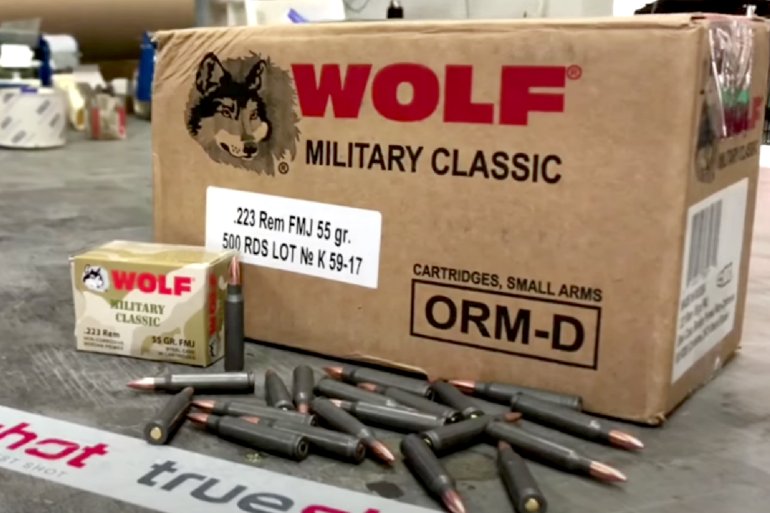
Some folks say never shoot steel-cased ammo in your gun because doing so will ruin it.
It seems logical as steel is normally harder than brass so it must be true. Or is it?
If steel is so inferior and destructive, why do many nations use steel when producing their ammunition. Are they not as enlightened as the United States? Is it because they’re dirty rotten commies? Maybe not so much. Especially considering that during WWII, the United States made .45ACP and .30 Carbine steel cased ammunition. Back then, with the war effort, brass became increasingly scarce.
Most rumors have some measure of truth to them. While steel can be harder than brass, ammo manufacturers anneal it to soften it to something approaching that of brass. So it’s not going to wreck your chamber in your AR-15.

Using steel offers a number of advantages including the big one: price. Other advantages include greater strength to contain chamber pressure, easier cleanup of spent rounds thanks to steel’s magnetic properties. It’s also lighter. And did we mention it’s cheaper and readily abundant? Before COVID, you could buy a 1000-round case about $100 cheaper than conventional brass ammo.
If you are a casual shooter like most folks, shooting a hundred rounds or fewer a year, the savings isn’t much. However if you shoot to develop your skills or shoot competitively, then the price differential kicks in quickly. 6000 rounds of savings adds up to $600 plus taxes.
So now what are the disadvantages of steel?
Probably first and foremost, the steel jacket of the bullets will wear your barrel much more quickly than copper and brass jacketed projectiles. You’ll need to shoot 5,000 to 6,000 rounds to see the effects on accuracy. Steel cases are not as malleable as brass and therefore it may not seal the fired cartridge case as well in the chamber, nor will steel retract as readily once pressure subsides. This sometimes leads to spent cases stuck in the chamber. It’s also why it will run dirtier due to the less-than-optimal sealing of the chamber.
Some of the Soviet-inspired cartridge cases like the 7.62×39 are made with a greater taper in their design to help overcome stuck case problem quite effectively. Recall how the Kalashnikov is renowned for its reliability and it earned that reputation by shooting steel almost exclusively.
Also, steel will rust if not treated in some way. Modern steel cartridge manufactures add a polymer coating to prevent rust. No, the polymer will not melt in the chamber as some suggest. To the contrary, the polymers used actually aid in extraction.
Steel can be harder to reload, so there’s that as well. But most folks don’t reload.
Overall, the real reason I shoot steel is because it makes trigger time more affordable. What’s more, it helps me develop and maintain skills.
Guns are tools and will last a long time with proper care and feeding. And just like any other tool, if you use it enough things will wear out. Don’t worry about it. Fix them the continue doing your thing.
Train and practice. The life you save with those skill sets might even be your own someday. Just ask the Ukrainians.
Comments are closed.