“In an organized society, there can be nothing but ultimate confusion and chaos if court decrees are flaunted.”
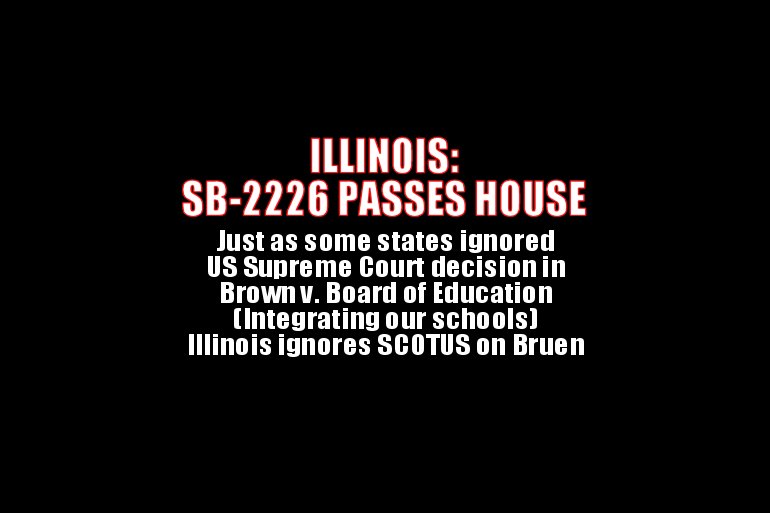
This morning, bright and early, the Illinois House voted to pass the gun and magazine ban contained in SB-2226 (House Amendment #3). Just as some states ignored the US Supreme Court decision in Brown v. Board of Education to end school segregation and allow blacks into the last of America’s segregated schools, the Illinois House has opted to ignore the rule of law and unconstitutionally restrict residents’ Second Amendment rights.
A few days ago, Chief Justice John Roberts submitted his 2022 Year End Report on the Federal Judiciary. In it, he opens with how some states took bold and decisive efforts to thwart the US Supreme Court’s landmark decision in Brown v. Board of Education to integrate the last of America’s segregated schools.
Images via Wikipedia.
Some states, like Arkansas bristled at the notion that black students should be allowed to learn alongside white students. Their racist and bigoted beliefs ran so deeply (see above photo) that Arkansas Governor called out the National Guard to ensure that black students would not be admitted into his precious “whites only” Little Rock schools.
In response, President Eisenhower nationalized the entire Arkansas National Guard and sent 1200 paratroopers from the 101st Airborne Division to ensure the “Little Rock Nine” could enter school unimpeded.
Images via Wikipedia.
The judge who heard a case three years later to force the issue, Judge Ronald Davies, wrote this afterwards:
“In an organized society, there can be nothing but ultimate confusion and chaos if court decrees are flaunted.”
Here we are today with the Illinois legislature voting to flaunt the US Supreme Court’s decision in Bruen. Just as GovernorOrval Faubus did trying to block black students from the still very segregated Little Rock schools following Brown.
Here’s Roberts’ intro…
For the handful of Paratroopers and Guardsmen on duty at Little Rock Central High School to welcome the New Year of 1958 on a quiet, crisp Arkansas night, it must have been hard to believe how hot the nearby streets had been just a few months earlier.
On September 23, 1957, nine African-American children—later known as the Little Rock Nine—had bravely entered the building to go to the formerly all-white school. This followed the Supreme Court’s 1954 decision in Brown v. Board of Education holding that school segregation by race was unconstitutional. The next year, in 1955, the Supreme Court directed that this vindication of the Constitution proceed “with all deliberate speed.” Not everyone was convinced. The states, the courts, and the people had more work to do.
The Little Rock School Board was finally preparing for integration in fall 1957 when Governor Orval Faubus ordered the Arkansas National Guard to prevent it. Wiley Branton, the local lawyer for the nine students and later dean of Howard University School of Law, called Thurgood Marshall to request his help with a federal lawsuit to order school integration consistent with Brown. Branton later recalled, “Governor Faubus had the full might of the State of Arkansas and its resources behind him in his effort to keep nine black children from entering Central High School, but I felt as though our side was almost an equal match when Thurgood came down and joined the battle.” Marshall, of course, was the pioneering attorney who had argued Brown v. Board before the Supreme Court, and went on to serve as a Supreme Court Justice from 1967 to 1991.
It fell to U.S. District Judge Ronald N. Davies to hear the case. That Judge Davies found himself in Little Rock at all, much less at a pivotal moment in history, was surprising. Born in Crookston, Minnesota, Davies attended high school in Grand Forks, North Dakota— where the federal courthouse today bears his name—and then starred as a sprinter at the University of North Dakota before attending law school at Georgetown University in Washington, D.C. He worked his way through law school, including a stint on the graveyard shift for the U.S. Capitol Police, and then returned home to start a law practice. President Dwight D. Eisenhower appointed him to the District Court in 1955, and Davies was just two years into his federal judicial career when Chief Judge Archibald Gardner of the Eighth Circuit tapped him for a special assignment briefly noted on an inside page of the August 22, 1957 edition of the Fargo Forum: “U.S. District Judge Ronald N. Davies of Fargo will leave Saturday for Little Rock, Ark. to preside at a term of the Eastern District of the U.S. Court of Arkansas. He will replace the presiding judge, who is ill.”
Judge Davies had no idea what cases he would draw upon his arrival. But when it came time to rule in the school desegregation litigation, Davies did not flinch. As he recalled years later, his decision did not involve any difficult legal interpretation: “It was purely a question of whether the Governor of the State of Arkansas could get away with the doctrine of interposition, placing himself between the Federal Government and the people of Arkansas. The law was very clear that the schools had to be integrated.” In deciding the case, Judge Davies said: “I have a constitutional duty and obligation from which I shall not shrink. In an organized society, there can be nothing but ultimate confusion and chaos if court decrees are flaunted.”
And that brings us to September 23, when the Little Rock Nine attempted to enter the school. An angry crowd encouraged by the Governor sought to block their path. In response, President Eisenhower issued a national proclamation ordering “all persons” to cease the obstruction of justice. He also federalized the 10,000 strong Arkansas National Guard, and deployed 1,200 paratroopers from the 101st Airborne Division—the “Screaming Eagles” out of Fort Campbell, Kentucky—to enforce the Court’s order and protect the children’s right to go to school. The troops stayed until Ernest Green became the first African-American graduate of Little Rock Central High School in May 1958.
Images via Wikipedia.
Some years later, the little Auxiliary Courtroom where Judge Davies had presided was decommissioned as part of a courthouse renovation. This past year, the U.S. District Court for the Eastern District of Arkansas worked with the General Services Administration—which manages government real estate nationwide—to recover the judge’s bench and other original courtroom furnishings. The District Court and GSA are, together, refurbishing an era-faithful courtroom in the working part of what is today the Richard Sheppard Arnold U.S. Courthouse so that these important artifacts will be used to hold court once again, and also for programs about the events of 1957 and the rule of law in our country. This coming May, students in the National High School Mock Trial Championship will pass through the same doors Thurgood Marshall used in 1957 on their way into the courtroom. In a few years, the original judge’s bench will be installed there, too. But first, GSA and the District Court have loaned the bench to the Supreme Court for a special exhibit that will open this fall and run for the next several years. The authentic bench will give visitors an opportunity to transport themselves in place and time to the events in Little Rock of 65 years ago. The exhibit will introduce visitors to how the system of federal courts works, to the history of racial segregation and desegregation in our country, and to Thurgood Marshall’s towering contributions as an advocate before he became a Justice. Come and visit the Court and—starting this fall— have a close-up look at the historic bench Judge Davies used.
Judge Davies missed his own son’s wedding to see through his charge to follow the law. We have roughly 2,000 federal judicial officers—Circuit Judges, District Judges, Magistrate Judges, Bankruptcy Judges, and more—who quietly, diligently, and faithfully discharge their duties every day of the year. Each of them makes sacrifices for a career in public service.
Judicial opinions speak for themselves, and there is no obligation in our free country to agree with them. Indeed, we judges frequently dissent—sometimes strongly—from our colleagues’ opinions, and we explain why in public writings about the cases before us. But Judge Davies was physically threatened for following the law. His wife feared for his safety. The judge was uncowed, and happily so were others who stuck up for the rule of law— not just with regards to the judge, but to even greater threats against the schoolchildren, their families, and leaders like the NAACP’s Daisy Bates. Following a bomb threat on the Sam Peck Hotel where Judge Davies was staying across the street from the courthouse, the judge offered to the proprietor to move elsewhere. Mr. Peck said, “no Judge, you stay right here.”
I want to thank the Members of Congress who are attending to judicial security needs— these programs and the funding of them are essential to run a system of courts. Judge Esther Salas, a U.S. District Judge in New Jersey, has been a brave, able, and admirable advocate for this cause since her son Daniel Anderl was murdered in 2020 when he answered the door to her home in what was meant to be an attack on her. Just this month, Congress enacted the Daniel Anderl Judicial Security and Privacy Act to help protect judges and their families. The law requires every judge to swear an oath to perform his or her work without fear or favor, but we must support judges by ensuring their safety. A judicial system cannot and should not live in fear. The events of Little Rock teach about the importance of rule by law instead of by mob.
I thank the U.S. Marshals, Court Security Officers, Federal Protective Service Officers, Supreme Court Police Officers, and their partners who are on duty as we ring in the year, working to ensure that judges can sit in courtrooms to serve the public throughout the coming year and beyond. They will make it possible for every American to visit a courthouse, because the buildings and what they represent belong to the public.
Once again this year, I am privileged and honored to thank all of the judges, court staff, and other judicial branch personnel throughout the Nation for their outstanding service. Best wishes to all in the New Year.



Comments are closed.