
by Damon Williams
(GSL) – In debating the sensationalized gun control hot button issue of so-called “ghost guns,” our side will argue, factually, that the right for Americans to build their own firearms dates back to the days prior to the founding of our Republic.
So why, over 250 years later, is an individual building his own firearm a “scourge of modern society” as it relates to gang violence?
In the 18th century gun making, the trade skills took years to master, and required expensive tools and equipment to do well.
However, even in the 21st century, while CNC machining has made production of components faster than any human can accomplish, but these machines are big, expensive, and highly specialized. But they still take skilled hands to put the finishing touches on the final product to make them work well.
Enter a company called Defense Distributed. This revolutionary company introduced a table-top CNC machine pre-programed to take a block of steel or aluminum and carves out a 1911 frame or an AR-15 lower.

In the mean-time, firearm technology has evolved to where non-pressure structural parts can be made with a lighter cheaper polymer materials which are much more easily shaped than steel or aluminum; i.e., Glock.
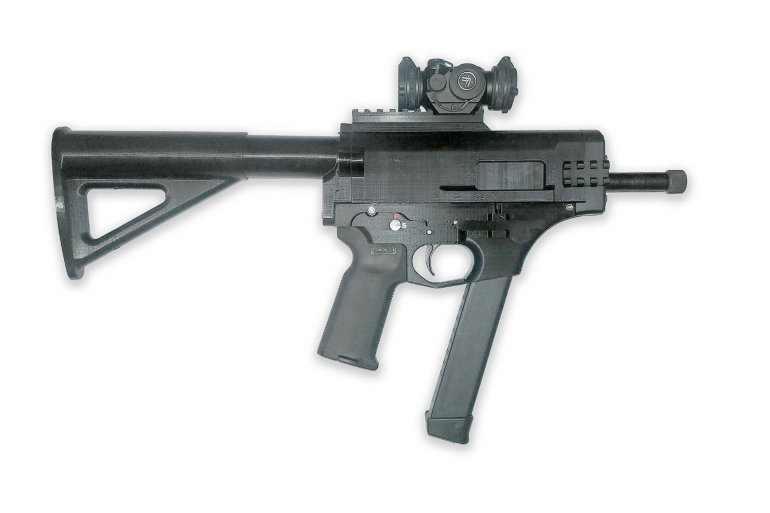
In recent years, a group of innovators (aka computer nerds) developed machines that can take computer drafted images and turn them into a three dimensional plastic reality.
With that 3D printing was born.
For those unfamiliar with the way 3D printing works, picture trying to build a sculpture with a hot glue gun. Start on a table and build your sculpture layer by layer. Now picture that same process with the precision of a computer navigated head melting a thread of plastic, layer by layer. The table moves front to back, the heated plastic nozzle moves side to side, as the nozzle is moved vertically after each 0.2mm layer. The plastic cools quickly after being deposited as it melts, or welds, itself to the previous layer.

Today, the most popular entry level machine is the Creality Ender 3 with a price around $200. The filament comes in 1kg (2.2lbs) rolls for under $25 in any color imaginable.
Obviously that’s affordable. So what about the designs?
Defense Distributed and other websites like DEFCAD, provide gun related 3D printable files readily available for download. Some of these designs fall well outside of the boundaries of the National Firearms Act. However, these sites are only sharing information. Information is protected by our First Amendment.

The free exchange of ideas and information cannot be restricted. Believe me, they have tried and failed in court cases against Defense Distributed. Should big government try to shut files down, and they will pop up on another server in an endless governmental game of “Whack-a-Mole”.
The slogan of 3D printers worldwide is simple: “You Can’t Stop the Signal.”
The parts themselves? They are cheap plastic. For instance, I’m travelling out of state and want to print a “plus two” extension for my Glock magazine. Let’s say I want to be a good citizen and not bring it back behind Pritzker’s Second Amendment Iron Curtain. Toss it in the trash; what is my loss? A little bit of time and a couple of bucks?
I concede, that the reliability of 3D printed firearms currently will never equal the quality of commercially manufactured components. But there is no question that they are functional, durable, and the designs are improving every day.

Meanwhile, the Illinois political climate is overtly attempting to compile a firearms registry of all firearms, including all private transfers disclosing make, model, and serial numbers. Then transfers can happen only under the permission of the crown.
We all know what follows gun registration.
Is it any wonder why these would-be political tyrants fear home built guns?
Comments are closed.