
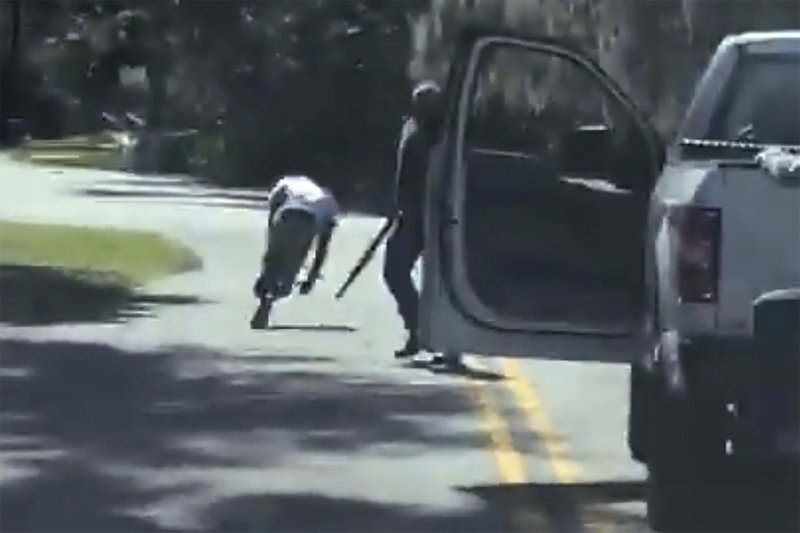

More and more people across America are staking out positions on the Ahmaud Arbery homicide in Georgia. Many folks are allowing their personal biases to enter into their personal take on what happened. And then there are politicians and pundits who are exploiting the case to advance their pet causes.
Leaving out the racial angle and dispassionately looking at the evidence relating to his death, Mr. Arbery’s death sure looks more like murder, not self-defense.
I offer this analysis to give readers some valuable insight should they ever find themselves in similar circumstances… and so they don’t end up on the wrong side of the law using deadly force over property.

What we know.
Initially, someone released a video of what appears to be Mr. Arbery running behind a pickup truck occupied by two men with guns (reportedly Gregory McMichael and his son Travis).

Here is the unedited version from LiveLeak.
The Arbery family has now hired one of the Trayvon Martin team to represent the young man’s estate. And while there may be a claim made that those two white guys hunted down Mr. Arbery for racial reasons, those are speculative and beyond the scope of this piece evaluating if the use of deadly force against the young black man was justified.

That video alone looks a whole lot like a couple of men in a pickup truck hunting down and killing a man jogging down a road.
And now, a second video has surfaced showing what appears to be Mr. Arbery burglarizing a construction site.
And some people believe that burglary video justifies those two men pointing guns at Mr. Arbery.
Not so much.
Here’s an example of someone who doesn’t know as much as they think they do about the law of self-defense.
Even if Mr. Arbery was burglarizing a construction site and stealing valuable tools, that’s not justification for using deadly force to stop him. Period.
Nor can someone legitimately and legally use deadly force to affect a “arrest” over a property crime.

While some states like Illinois (and apparently Georgia) have a provision allowing the use of deadly force to prevent commission of a forcible felony (and burglary is a forcible felony), the US Supreme Court has ruled that you can’t use deadly force against a suspect for a property crime (burglary).
In fact, the case in question, Tennessee v. Garner, has very similar circumstances to this case. Only in this case, the people shooting an alleged fleeing felon (burglar) weren’t even cops!
Tennessee v. Garner, 471 U.S. 1 (1985)
Tennessee v. Garner
No. 83-1035
Argued October 30, 1984
Decided March 27, 1985*
471 U.S. 1APPEAL FROM THE UNITED STATES COURT OF APPEALS FOR THE SIXTH CIRCUIT
Syllabus
A Tennessee statute provides that, if, after a police officer has given notice of an intent to arrest a criminal suspect, the suspect flees or forcibly resists, “the officer may use all the necessary means to effect the arrest.” Acting under the authority of this statute, a Memphis police officer shot and killed appellee-respondent Garner’s son as, after being told to halt, the son fled over a fence at night in the backyard of a house he was suspected of burglarizing. The officer used deadly force despite being “reasonably sure” the suspect was unarmed and thinking that he was 17 or 18 years old, and of slight build. The father subsequently brought an action in Federal District Court, seeking damages under 42 U.S.C. § 1983 for asserted violations of his son’s constitutional rights. The District Court held that the statute and the officer’s actions were constitutional. The Court of Appeals reversed.
Held: The Tennessee statute is unconstitutional insofar as it authorizes the use of deadly force against, as in this case, an apparently unarmed, nondangerous fleeing suspect; such force may not be used unless necessary to prevent the escape and the officer has probable cause to believe that the suspect poses a significant threat of death or serious physical injury to the officer or others. Pp. 7-22.
[2]
(a) Apprehension by the use of deadly force is a seizure subject to the Fourth Amendment’s reasonableness requirement. To determine whether such a seizure is reasonable, the extent of the intrusion on the suspect’s rights under that Amendment must be balanced against the governmental interests in effective law enforcement. This balancing process demonstrates that, notwithstanding probable cause to seize a suspect, an officer may not always do so by killing him. The use of deadly force to prevent the escape of all felony suspects, whatever the circumstances, is constitutionally unreasonable. Pp. 7-12.
(b) The Fourth Amendment, for purposes of this case, should not be construed in light of the common law rule allowing the use of whatever force is necessary to effect the arrest of a fleeing felon. Changes in the legal and technological context mean that that rule is distorted almost beyond recognition when literally applied. Whereas felonies were formerly capital crimes, few are now, or can be, and many crimes classified as misdemeanors, or nonexistent, at common law are now felonies. Also, the common law rule developed at a time when weapons were rudimentary. And, in light of the varied rules adopted in the States indicating a long-term movement away from the common law rule, particularly in the police departments themselves, that rule is a dubious indicium of the constitutionality of the Tennessee statute. There is no indication that holding a police practice such as that authorized by the statute unreasonable will severely hamper effective law enforcement. Pp. 12-20.
(c) While burglary is a serious crime, the officer in this case could not reasonably have believed that the suspect — young, slight, and unarmed — posed any threat. Nor does the fact that an unarmed suspect has broken into a dwelling at night automatically mean he is dangerous. Pp. 20-22.
Some also said that Mr. Arbery had a hammer while “jogging.”
Doesn’t matter here.
A reasonable and prudent person would not chase after someone with a hammer. And someone either in the bed of a pickup or in the passenger compartment would have a hard time claiming they feared for their safety from a hammer wielding kid when they could have simply driven away (or even idled away) from their alleged attacker.
One big question mark is why Mr. Arbery was jogging towards the pickup truck in the video. If he was in fear for his life, or trying to escape those men, why wouldn’t he be running with a lot more vigor AWAY from the truck and the roadway? After all, a truck can’t drive through trees. That sure seems to bolster the case that the pickup truck’s occupants ambushed the young man rather than pursued him.
Sure, the two armed men may have believed (and even with good cause) that Mr. Arbery had burglarized a work site. They may have even thought he stole some items. Even more, they might have known about the deceased’s previous criminal history.
None of that gave them the right to even threaten deadly force against Mr. Arbery. Much less shoot him dead.

Sure, some will say that Mr. Arbery was trying to disarm one of his killers and his killer shot to protect himself. Yes, Mr. Arbery probably was trying to disarm his attacker. But the man he was trying to disarm was committing a felony against the young black man. As a supposed good guy, you don’t get to claim the mantle of self-defense when you’re committing a felony.
And in fact, if you had a hand in escalating the conflict (such as flipping someone the bird in a road rage incident), you may have lost your ability to claim self-defense if the situation escalates and you use deadly force. Or in this case, ambushing an unarmed man jogging down the road by pulling guns on him and holding him against his will.
In fact, the first video of the shooting seems to show just that. These two men can’t claim that the unarmed Mr. Arbery satisfied the “ability, opportunity and jeopardy” three-part test for the justifiable use of deadly force.
- Ability: a man jogging vs. men in a pickup truck? Not so much.
- Opportunity: an unarmed man on foot vs. men in a vehicle? No.
- Jeopardy: Would a reasonable and prudent person believe that Mr. Arbery posed a threat of death or great bodily injury to the men in the truck. No.
Again, even if Mr. Arbery had a hammer, he would pose a threat of great bodily injury to the two men only if they pulled beside him and allowed him a free swing at them with their windows down.
The bottom line: You are virtually NEVER justified in using deadly force to defend property (or to make a “citizen’s arrest” for the same). DON’T DO IT.
And if you escalate a confrontation over the theft of property into a deadly force incident, you may in fact jeopardize your mantle of innocence required to justifiably use deadly force against another individual.
These two men will likely face trial. And absent some pretty profound physical evidence not yet made public, they’ll probably face a conviction in the homicide of Mr. Arbery, officially making his death a murder.
Then the Arbery family attorneys will move on the civil action to take any assets his attackers owned… Houses, boats, land, business interests, vehicles, tools and anything else they can attach a judgement against.
All because these two yahoos thought it okay to chase down and then murder a man they thought *might* have stolen something from a construction site. In other words, justice will be served and rightfully so.
Comments are closed.