
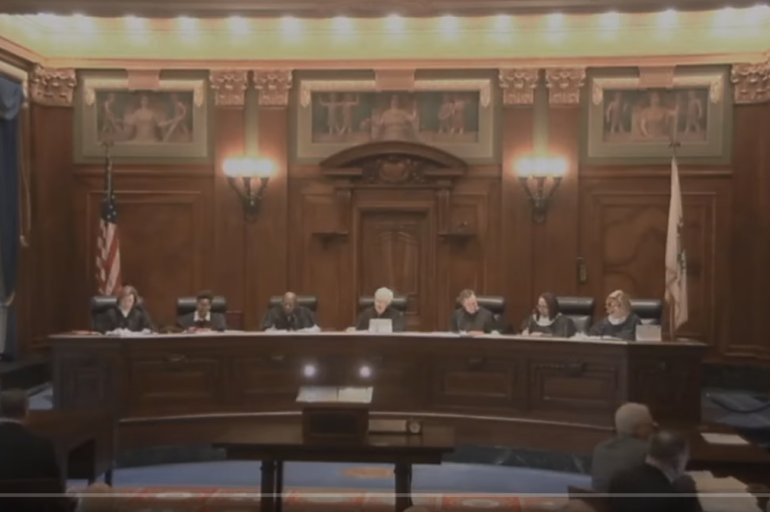
We have some video highlights from yesterday’s Illinois Supreme Court oral arguments in Kwame’s challenge of a Macon County court’s ruling striking down the PICA gun and magazine ban. Thank you Greg Bishop for putting this together. And by the way, when it comes to the video, is Illinois so poor and backwards that they can’t have a camera system any newer than 1973 in vintage to view these cases?
A couple of things to keep in mind when it comes to analysis and I’m not going to bury these in a 20-minute YouTube video.
First off, note Kwame Raoul right there front and center. The cynic in me takes that as a sign that the outcome is baked into this already. If Kwame thought he was gonna lose this, he wouldn’t have made an appearance. It wouldn’t be a good image. But if he knows he’s going to win, he can tout “I was there!”
Second, ignore the chaff. Caulkins’ case had NOTHING to do with the Second Amendment. Yes, the law in question has everything to do with gun rights, HOWEVER, he (and his lawyer Jerry Stocks) didn’t file suit on the Second Amendment-related claims. They filed it using Tom DeVore’s template (kudos and credit go to Bazooka Tom for his original case) of challenging it under “Equal Protection” claims under the Illinois Constitution. Yes, there were a couple of other aspects related to procedural issues challenged, and even briefly discussed in the hearing, but those weren’t upheld by the 5th Circuit Appellate Court in Illinois (which formed the basis for the ruling from Macon County striking down the law), so they weren’t on the menu yesterday.
When Jerry Stocks stood up he mentioned how his pleading raised the Second Amendment issues, but they’re not relevant to this case and to this court. Remember, the ONLY thing the Illinois Supreme Court is pondering is whether or not the correct standard was used by the Fifth Circuit Appeals court to sustain the initial claim by DeVore in his original case (in Effingham if I recall correctly).
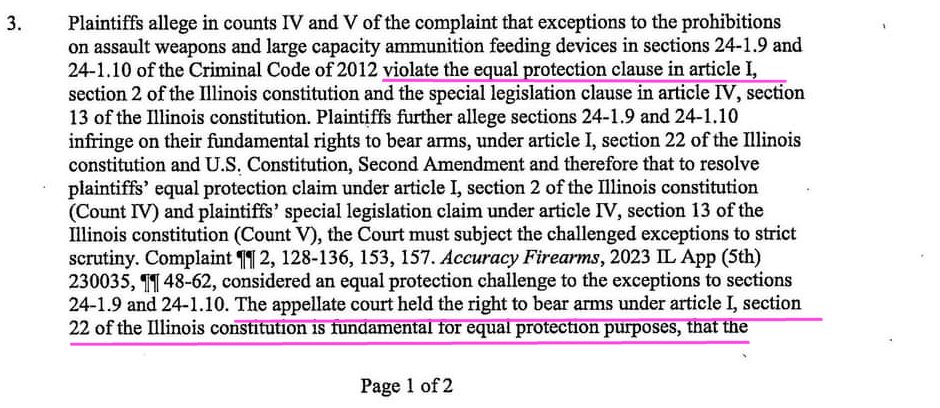
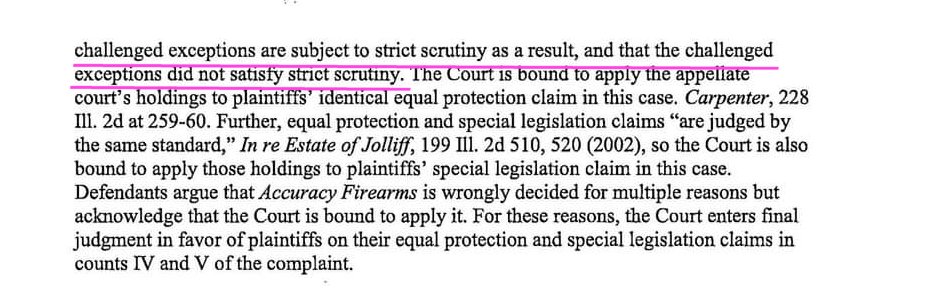
I’ve written about it before months ago. The Illinois Supreme Court will NOT uphold the Macon County ruling to strike down the law under “Equal Protection.” They will say the wrong standard was used. Instead of “strict scrutiny,” the ISC will say that intermediate scrutiny (“Rational Basis” is another way of saying the same thing) should have been used. Here, I’ll pull it up, from March 3rd:
WHAT HAPPENS NEXT?
The odds on thinking is that the Illinois Supreme Court is not going to let this order stand.
You want to know how they’re going to overturn this order?
Right here:

“The appellate court held… that the challenged exceptions are subject to strict scrutiny as a result…”
The Illinois Supreme Court will rule that the wrong standard was used. They will rule that intermediate scrutiny was the appropriate legal standard of review given that this is an “Equal Protection” issue, not a Second Amendment challenge (subject to Bruen’s text, history and tradition / strict scrutiny standard). What’s more, the belief is that the ruling will come down 4-3, allowing one of the Dem Supreme Court justices to vote for upholding the order to make it look like it wasn’t a “partisan” decision.
If the IL Supremes do allow this order to stand, it will kill our federal lawsuit as the case will be “mooted” out.
To that point, pay close attention to 5:00 or so with Justice Overstreet and 5:54, with Chief Justice Theis asking, “Why are we talking about the Second Amendment at all?” She’s spot on. Ignore the idiot from Kwame’s office.
Greg Bishop pulls up the interaction between the Million Dollar Baby Lizzy Rochford and Jerry Stocks. Stocks does a good job with it, but frankly it was irrelevant.
Jerry seriously failed when asked by the Chief Justice this question:
Justice Theis: “Has the United States Supreme Court or Court of Appeals across this country said that there is a constitutional right to keep and bear assault weapons?”
The correct answer SHOULD have been: The Heller decision affirmed a right to keep and bear arms in common use for lawful purposes. Period. Full stop.
Here, I’ll quote from the Heller Decision:
Held:
1. The Second Amendment protects an individual right to possess a firearm unconnected with service in a militia, and to use that arm for traditionally lawful purposes, such as self-defense within the home. Pp. 2788 – 2816.
(a) The Amendment’s prefatory clause announces a purpose, but does not limit or expand the scope of the second part, the operative clause. The operative clause’s text and history demonstrate that it connotes an individual right to keep and bear arms. Pp. 2788 – 2799.
(b) The prefatory clause comports with the Court’s interpretation of the operative clause. The “militia” comprised all males physically capable of acting in concert for the common defense. The Antifederalists feared that the Federal Government would disarm the people in order to disable this citizens’ militia, enabling a politicized standing army or a select militia to rule. The response was to deny Congress power to abridge the ancient right of individuals to keep and bear arms, so that the ideal of a citizens’ militia would be preserved. Pp. 2799 – 2803.
(c) The Court’s interpretation is confirmed by analogous arms-bearing rights in state constitutions that preceded and immediately followed the Second Amendment. Pp. 2802 – 2804.
(d) The Second Amendment’s drafting history, while of dubious interpretive worth, reveals three state Second Amendment proposals that unequivocally referred to an individual right to bear arms. P. 2804.
(e) Interpretation of the Second Amendment by scholars, courts, and legislators, from immediately after its ratification through the late 19th century, also supports the Court’s conclusion. Pp. 2804 – 2812.
(f) None of the Court’s precedents forecloses the Court’s interpretation. Neither United States v. Cruikshank, 92 U.S. 542, 553, 23 L.Ed. 588, nor Presser v. Illinois, 116 U.S. 252, 264-265, 6 S.Ct. 580, 29 L.Ed. 615, refutes the individual-rights interpretation. United States v. Miller, 307 U.S. 174, 59 S.Ct. 816, 83 L.Ed. 1206, does not limit the right to keep and bear arms to militia purposes, but rather limits the type of weapon to which the right applies to those used by the militia, i.e., those in common use for lawful purposes. Pp. 2812 – 2816.
2. Like most rights, the Second Amendment right is not unlimited. It is not a right to keep and carry any weapon whatsoever in any manner whatsoever and for whatever purpose: For example, concealed weapons prohibitions have been upheld under the Amendment or state analogues. The Court’s opinion should not be taken to cast doubt on longstanding prohibitions on the possession of firearms by felons and the mentally ill, or laws forbidding the carrying of firearms in sensitive places such as schools and government buildings, or laws imposing conditions and qualifications on the commercial sale of arms. Miller‘s holding that the sorts of weapons protected are those “in common use at the time” finds support in the historical tradition of prohibiting the carrying of dangerous and unusual weapons. Pp. 2816 – 2817.
3. The handgun ban and the trigger-lock requirement (as applied to self-defense) violate the Second Amendment. 2787*2787 The District’s total ban on handgun possession in the home amounts to a prohibition on an entire class of “arms” that Americans overwhelmingly choose for the lawful purpose of self-defense. Under any of the standards of scrutiny the Court has applied to enumerated constitutional rights, this prohibition—in the place where the importance of the lawful defense of self, family, and property is most acute—would fail constitutional muster. Similarly, the requirement that any lawful firearm in the home be disassembled or bound by a trigger lock makes it impossible for citizens to use arms for the core lawful purpose of self-defense and is hence unconstitutional. Because Heller conceded at oral argument that the D.C. licensing law is permissible if it is not enforced arbitrarily and capriciously, the Court assumes that a license will satisfy his prayer for relief and does not address the licensing requirement. Assuming he is not disqualified from exercising Second Amendment rights, the District must permit Heller to register his handgun and must issue him a license to carry it in the home. Pp. 2817 – 2822.
Instead, at about 15:00, Jerry said Heller protected handguns. Yes, it protects handguns (see #3 in the holdings above), but more importantly it recognizes protection under section 1(f) of all guns in common use for lawful purposes.
Now, Jerry does a nice job articulating his argument starting around 16:00 or shortly after.
And here comes Million Dollar Baby Lizzy at 17:00… blah blah blah.
Good point at 18:15 of Jerry pointing out that “grandfathering” of existing owners as compared to future owners is another violation of equal protection.
19:20: Chief Justice Theis talks that this isn’t a 2A case. *THIS* is the crux of the case, or at least those issues for the Illinois Supreme Court to contemplate in this case related to the decision they’re evaluating. If the IL Supreme Court recognized that strict scrutiny should be applied for all equal protection claims, it would cause a whole lot of other laws in Illinois to become ripe for overturning. Courts don’t go out of their way to create more work for themselves.
The “bad” news is that Caulkins will lose his earlier trial court win at the Illinois Supreme Court. But THAT is REALLY, REALLY GOOD NEWS in that it allows our federal cases to move forward. Should Caulkins win here, our federal cases will be mooted out of court and we’ll have to start from scratch after the General Assembly passes a new gun ban, better written to make it more resistant to legal the challenges we’ve raised this round.
Someone asked me yesterday evening if I thought Tom DeVore would have done a better job arguing the case instead of Stocks. Well, that’s a very big hypothetical. Very apples and oranges because it wasn’t DeVore’s claim but rather Caulkins’. On DeVore’s case as a whole? Eh, maybe.
But it wasn’t and it isn’t. I’m not sure former US Solicitor General Paul Clement himself could have done a much job yesterday on the key point. When you take away all of the extraneous decorations, this case hinges upon “is ‘strict scrutiny’ the appropriate standard in evaluating the ‘equal protection’ claim at the 5th District Appellate Court, or should they have used rational basis/intermediate scrutiny?” Precedent seems to suggest “rational basis” and on that ground, Caulkins/Stocks lose.
That’s my hot take revisiting yesterday’s hearing. Feel free to offer yours in comments. Or criticism of my analysis.
Comments are closed.