
By Damon Williams; GSL Member
Before 2012, I used to cast my own bullets from discarded wheel weights. That year, the EPA banned the use of lead wheel weights on automobile rims. (Thanks, Obama!)
Up until that time, recognizing the risk, I monitored my blood lead levels and kept them in check with prudent practices. When I quit casting, I quit monitoring my levels and became complacent about lead exposure mitigation.
At a recent checkup, my doctor ordered a blood screening. I asked for a blood lead screening as it had been 13 years since my last lead test. The results came back twice what I expected and three times above what is accepted as normal. My doc was keen for me to take actions to mitigate my exposure, pronto.
After this consultation and careful consideration, I will no longer be running the shot timer in competitions until my condition improves.
The response from my friends was shocking. Apparently, I have now joined the ranks of a hidden (secret?) society within the shooting community. “The Order of Elevated Lead Levels.” It’s a society that you really would be best off avoiding.
While my numbers were rookie numbers compared to some of these guys, I prefer taking my health seriously and taking good care of myself. According to the EPA, high lead levels in adults like me can lead to: memory loss, irritability, depression, high blood pressure, kidney problems, digestive problems, decreased sex drive and function, fatigue, joint and muscle pain, nervous system problems.
It ain’t so great for kids either.
So, let’s look at significant sources of lead exposure and how to mitigate ingestion.
Steel targets: Lead projectiles disintegrate/splatter into dust that coats the steel targets, stands and the ground beneath them with lots of lead powder. Yes, even if they’re jacketed rounds (something not recommended for close-in shooting on steel, by the way.)
Solution: Avoid handling steel targets with your bare hands. If you are setting a popper or plate rack for a competition stage, or resetting a Texas star, you have to sometimes man-handle the steel. Wear gloves or, at least, wash your hands thoroughly and frequently with soap and cold water.
Competition timer operators: In competition, the timer operator is your primary safety officer. He must be within arm’s distance at all times, so he is exposed to not only his own gunshot residue, but the residue of every shooter he times.
Solution: If you are a timer operator, consider shorter shifts. Maybe 100 to 150 rounds per stage, then hand the timer off to another qualified timer. This can substantially reduce your residue exposure. I’m considering giving up the timer entirely. At the same time, how can I in good conscience, expect a colleague with a higher lead level than mine to continue exposing himself at the expense of mitigating my own exposure?
Recovering brass: Maybe more of a common practice for not only cowboy shooters but shooters who reload or collect brass for friends who reload… we are exposing themselves to a lot of lead residue. This includes your kids who might be picking up brass (like many of us did as kids).
Solution: Minimize handling brass with your bare hands. Use pick-up tools (like the pickup tools for older folks) and a container to drop the cases into. Try to wear nitrile gloves or, at least, wash your hands thoroughly with cold water.
Brass tumbling: In my opinion, this is one of the leading causes of lead exposure, rivaling bare hands on steel targets. Dry vibratory tumblers, by design, cause the lead contaminated fouling to accumulate in the media and pretty much everywhere else. These levels compound every time you tumble a new batch. Dry tumblers leach particulate out of the lid as the machine stirs the media around and around for hours. Oh, but wait! The best part is separation at the end of the polishing cycle. The media has to pour through a sifter or spill through a rotating cage slinging dust and media in all manner of unintended directions. Breathe deep! (Just kidding.)
Solution: For the love of all that is holy, run your tumbler outdoors, never indoors, and away from traffic areas. Use a separator that fully encloses the cage. Wear a respirator when transferring media between containers. Allow time for dust to settle. Again, try to wear gloves or, at least, wash your hands thoroughly with COLD water. Better yet, use a wet tumbler, I understand that wet tumblers do a better job anyway. Still wear gloves and wash your hands.
Reloading: Now that we have shiny clean brass, do you think that the contamination has disappeared? The polishing compound will leave a waxy film to adhere contamination to the case surface. Each case will swipe fresh contamination into your dies and carry away contamination from previous cases. Are you setting a lead bullet on the case with your bare hands?
Solution: Again, try to wear gloves or, at least, wash your hands. If you are not loading jacketed bullets, consider powder coated or moly-coated projectiles. (These projectiles are considerations for gunshot residue as well.)
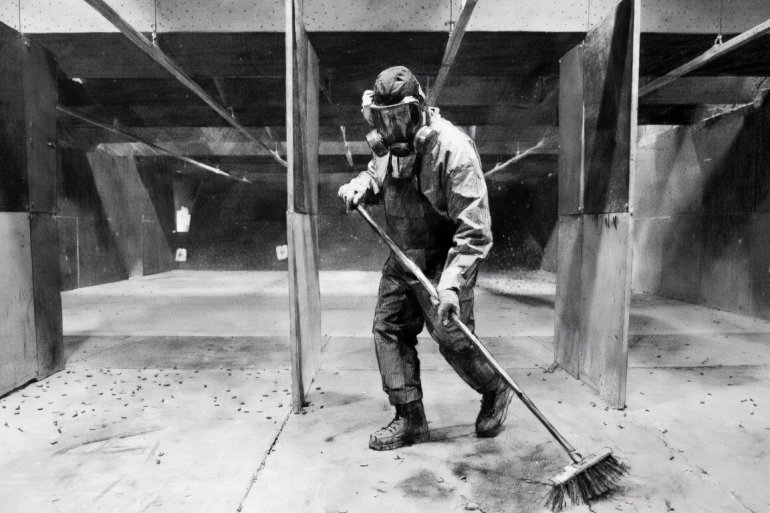
Indoor shooting: Probably the greatest exposure source for non-reloaders. Many of my “high score” colleagues got much of their contamination from indoor competition shooting. We often stress continual practice to hone marksmanship skills, and most city-folk outside of Chicago (America’s largest outdoor shooting range) have few options but to visit an indoor range. Yeah, it’s kind of a catch-22 situation.
My colleagues shoot indoor competitions down range of the established firing line. They tromp through huge amounts of lead dust and particulate splatter from the backstop and the back-splatter not captured by the bullet trap. They shoot closer to the backstop exposing themselves to even more back-splatter.
Solutions: Well, I don’t have many. Indoor competition shooters; set aside a dedicated pair of indoor range shoes. Transport them in a plastic bag. Change clothes after the match. Shower when you get home after washing your hands with cold water. Assess your risk, choose according to your priorities.
As for the occasional shooter who rents an indoor lane, use common sense and carefully wash your hands and then face with cold water to wash away the bulk of the lead from your skin. Don’t eat while shooting. Don’t have any open containers of liquids, even on an outdoor range.
Other don’ts: Don’t shoot or handle cases while pregnant. Don’t wash your hands with warm or hot water as this will opens your skin pores allowing lead to penetrate through the skin into your body. Minimize time your kids handle spent cases, loaded ammo or dirty guns. Make darn sure kids wash carefully with soap and cold water after handling guns/ammo/cases/supplies. Lastly, gents, if you’ve gotta pee, wash your hands first.
I’d hate to see my comments become detrimental to the patronage of an indoor range because I believe that unless you do dumb things as an occasional indoor range user, it is safe.
Finally, buy some heavy metal disposable wipes: Consider purchasing a container for your reloading bench, range bag, or gun cart. They are not cheap, 150 wipes cost about $22. Let’s face it, I am not going to start shooting with nitrile gloves when it’s 95 degrees in the shade. I still need to handle my contaminated reloads in preparation for each stage, or even practice. These wipes serve as a backup to when you forget to take precautions as well as you should or would like to do.
I’m not trying to wave a haughty wagging finger at my readers as result of my own complacent behavior. Health choices are still an individual decision. If I have brought into your consciousness some considerations that you had not pondered to help you reduce your lead in your life, then I have succeeded in my intended task. It all starts with a base-line blood test.