
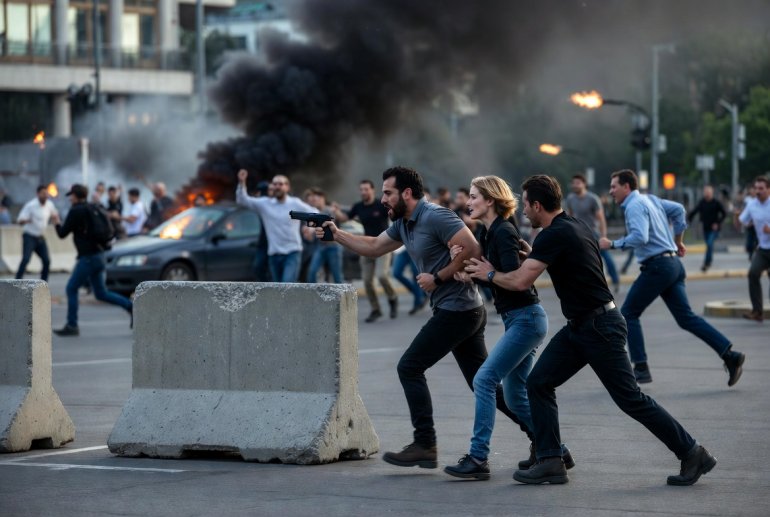
In an era of increasingly complex terror attacks—vehicle rammings followed by explosions and coordinated gunfire—preparation can mean the difference between life and death for you and your family.
Keith Graves’ powerful new piece, “Surviving a Complex Terror Attack,” delivers straight-talk, practical wisdom every survival-minded reader needs. Drawing from real-world threat patterns and grounded in biblical discernment (Luke 12), Graves reminds us: the first explosion or scream is rarely the end. Your mission isn’t to play hero and clear the building — it’s to get your loved ones and others out alive.

Key takeaways include:
- Move deliberately and laterally from oncoming vehicles
- Seek real cover (concrete barriers, not parked cars)
- Always anticipate follow-on attacks
- Carry a compact trauma kit to stop severe bleeding once clear
- Use your firearm to break contact and reach safety — never to hunt threats in chaos
Graves stresses smart pre-planning: know multiple exits, set family rally points, and mentally rehearse scenarios. “Movement is life” and “preparation is not about fear — it is about seeing clearly and acting wisely.”
This isn’t fear-mongering. It’s responsible stewardship. Read it today — it could save your life and the lives of those you love.
Movement Is Life
In most cases your best option is movement. That movement must be deliberate.
If a vehicle is bearing down on you, move laterally. Do not try to outrun it straight ahead. Vehicles are faster than people. Get behind something that can stop a moving vehicle such as large concrete barriers, heavy planters, thick structural columns, or the corner of a solid building. A parked car will not reliably stop a speeding vehicle.
If you move inside a building, get well inside and away from entrances and glass. Vehicles can travel farther than people expect once they crash through doors or windows.
If you are caught in a crowd, work toward the edges instead of letting the crowd carry you. Face the direction you want to move and protect your balance. Move diagonally when possible and avoid pushing directly against the flow. Look for service exits, side corridors, or alternate routes rather than funneling into the same doorway everyone else is using.
Do not stop at the first place that feels quieter. Stop when you are confident you are outside the attack pattern.
Your Gun Is a Tool to Get to Safety
A firearm can be useful in a crisis, but it is not a counterterror strategy.
In a large chaotic attack you may be dealing with multiple attackers, different weapons, and a police response arriving quickly. Your firearm is primarily a tool to break contact if someone blocks your path to safety.
Trying to hunt attackers in a crowded environment is extremely dangerous. You could be killed by another attacker you did not see, or mistaken for the attacker by responding officers or another armed citizen.
Carry reliable equipment and train with it. If you carry a handgun you should be able to deploy it quickly and make accurate hits under stress. If you cannot do that, the gun will not solve the problem by itself.
Also remember that a handgun or rifle will not stop a moving vehicle.
Medical Gear Often Saves More Lives
Severe bleeding is one of the most common preventable causes of death in violent incidents.
A small trauma kit can make a significant difference. A tourniquet, compression bandage, gauze, and shears take very little space but can keep someone alive until professional help arrives.
If you are able to move after an explosion or attack, your first step is still to leave the immediate danger area. Once you are outside the kill zone you can address life threatening bleeding.
If a loved one is wounded but can be moved, getting them away from the scene may be the most important action you take.
READ THE WHOLE THING.